You’re saying that under the assumption that a rest area would never be entered as a destination or stop point. That is an assumption I can’t support.
My more long winded version of Alan’s response: Say I’m routing from New Castle, DE to Twin Rivers, NJ. Waze routes me up the Jersey Turnpike. I now add-a-stop for gas selecting “Sunoco Milepost 39 New Jersey Turpike North.” My route is now the following:
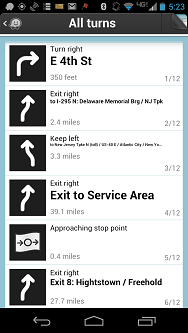
I will receive the the instruction to Exit right at Exit to Service Area based on the ramp name here: https://www.waze.com/editor/?lon=-74.8928&lat=39.97681&zoom=4&layers=BFTFFTTTTTTTTTTTTTTTTTTFT&segments=66881248
(Not sure why we name the entrance ramp though.)
Are we talking about rest areas or service areas? I realize you can search for service areas, and route to them. Not the same thing.
Please show me how to do this.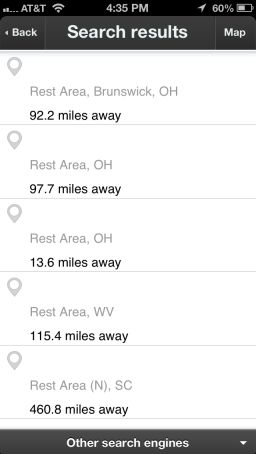
Being that this standard hasn’t been implemented yet, you’re going to have a hard time doing that.
Via my iPhone 4S.
Traveling I-5 in Oregon, add a stop, and it works OK. The road names aren’t quite figured out right, but with the proper naming, I think it will be fine.
Good catch. Done.
Going back to ramp naming, I thought a ramp segment only needs to be named if the GS at its approach says something different from the next named segment along any possible route through that ramp segment.
For example, for a ramp exiting to a Service Area for which all the parking lot roads within it are called “Service Area” - unless the approaching sign on the highway says something else, the ramp does not need to be named, nor should it be, to promote simplification.
Likewise, if the sign at the approach back to the highway from the rest area or service area only mentions the highway number and cardinal direction, the ramp does not need to be, nor should it be named, since that information already in the highway it’s connecting to.
I agree that any kind of street/ramp/parking lot naming in a simple rest or parking area with no searchable POI’s is moot and should probably be omitted. When resuming your trip after stopping there, Waze will automatically pick up the name and cardinal direction of the highway at its exit, so ramp naming is once again not needed.
This has never been a standard for ramps. Only for at-grade connectors.
The current proposal is that the internal roads in the rest/service area are left unnamed.
Would a landmark instead show its name or that its a rest area?
In that case, shouldn’t the exit ramp at least say something like “Exit to Rest Area” to make navigation work right if a rest area is used as a waypoint? It might not have an address or a business, but it still has lat/lon coordinates.
From the draft:
Then should this section of the draft be changed?
That’s not what this says…
The only part of that link that I can see that could be construed to mean that is this:
That only refers to a single ramp that splits into multiple ramps. That doesn’t refer to what’s at the end of the ramp. It’s done to avoid a chain of navigation instructions that can often take longer for TTS to spit out than it takes to cover the length of the first ramp segment.
…and if a ramp system splits 3 or 4 times? Similarly, what if the only sign at an entrance approach is the highway shield and a cardinal direction?
Then the last legs of the ramps are named. I would have to see an example of this type of sign.
I don’t see how any of this is relevant to Rest Areas.
I agree with Jason, it depends on the sign. You don’t name the ramp where the BGS is essentially multiple signs like here: http://goo.gl/maps/9SpUI
Right. I was just thinking like with at-grade connectors, if a nameless segment, ramp or not, automatically picks up the name of the next named segment along the route and the parking lot routes are named Rest Area (or whatever) then the approach doesn’t need to be named.
However, it looks like since things have developed so that the parking lot roads inside a rest area (or whatever) won’t be named, so the point is moot.
Sorry for any confusion.
Your list looks nearly as useless as the one I got.
My suggestion was made in the spirit of not asking people to do a tremendous amount of extra work for negligible gain, especially since it’s likely that this will not work out as hoped.
@CBenson: yes, I believe the instructions need to make a distinction between rest areas and service areas/service plazas/oases, because they are different entities. Same for truck scales, chain-up areas, etc, etc.
I think this looks very good. Thanks for doing it.
Comment: What about weigh stations? This would seem to be a type of service station. Some are simple, some integrated with truck stops and the like. Ramps would be marked as “weigh station.”
Comment: Are any locations open certain hours? Future update to Wiki once such features are available.
Comment: if these include full service stops, then one might not want to landmark everything, but also landmark the service station type, food, etc. the NY State turnpike or other state-captive road would have these. If not, state they should be treated a different way.
At some point in the future it would be nice if there was a way to list accommodating types… What is there at the location. Some are just pullovers with a trash can, and maybe a bush to pee behind if you’re brave. Others are full service.