Here in MS, we have very few divided stretches on highways and many areas without mobile data coverage.
Because of this, the standardized classification of Federal and State for BRs and MSs causes the Waze routing algorithm to produce bizarre routes that are frequently questioned in URs.
This happens because Waze, lacking speed data on segments (due to the lack of a mobile data network), prioritizes Major Highways (which we define in Brazil as federal highways) over State highways (Minor Highways).
The physical reality, however, is that practically all of them, whether BRs or MSs, are single-lane roads, so the shortest distance ends up prevailing.
Another problem is that marking BRs or MSs as unpaved doesn’t stop drivers from being routed through them, even if they have opted not to use unpaved roads in the app.
I propose the following, and I’ve opened this topic to weigh the pros and cons:
With this, we would maintain the current “Federal” or “State” labels, except in the case of unpaved roads.
With neutral/preferred and avoid routing, we would equalize a single-lane BR (it would be a federal/avoid) and a single-lane MS (State/neutral).
What do you think?
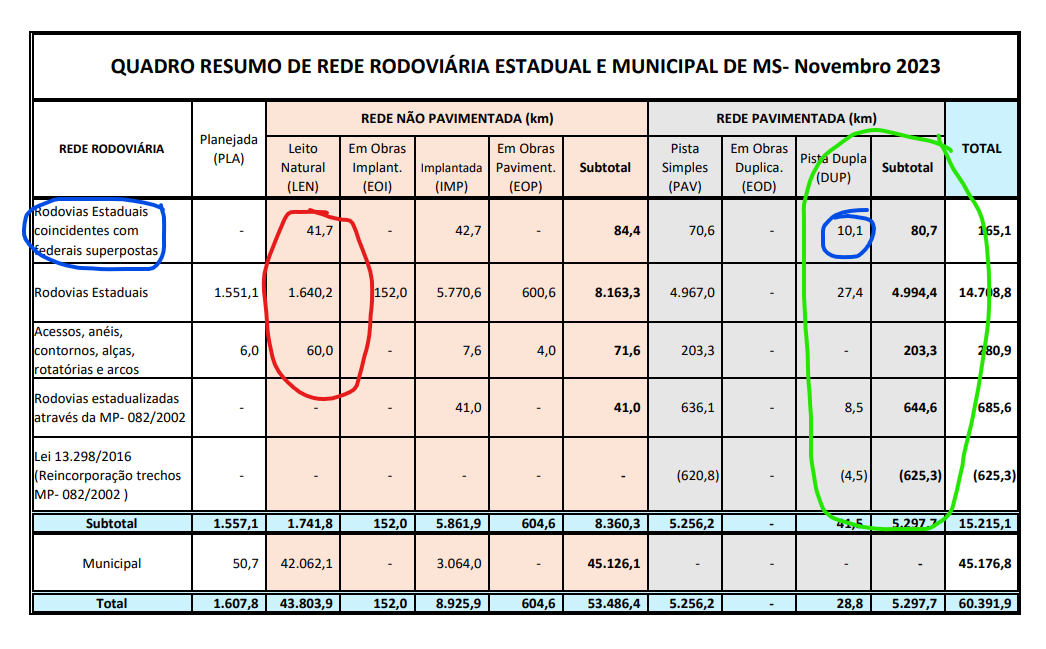
I found this PDF with a map from 2019. On the BRs in MS, only a stretch from Dourados to the northeast, one near Ponta Porã, one near Jardim, and one near Maracaju appear as dual carriageways. BR-419 is listed as “Leito natural” (natural bed), which is a euphemism for unpaved. BR-376 is also in this situation in a section near Paraná.
I’m going to look for something for MS.
I think it’s worth, before getting to work, organizing a spreadsheet or something similar to mark what needs to be done, what to do, and mark what’s finished.
I agree that the proposal presented is quite valid and can certainly bring important improvements to routing within Mato Grosso do Sul, especially considering the state’s particularities regarding the low number of dual carriageways and the large areas without mobile data coverage. The suggested differentiation between single and dual-carriageway BRs and MSs tends to make the routes more consistent with the physical reality of the roads.
However, I have a concern regarding the impact on longer-range routes that start or end outside of Mato Grosso do Sul, or even both. A practical example would be a route starting from the interior of São Paulo towards Mato Grosso, which naturally passes through Campo Grande. In this scenario, could the new classification logic potentially induce the Waze algorithm to suggest longer alternative routes that spend less time within the state, precisely because of the weight difference assigned to the roads?
I don’t think so. What we’ll do is equalize all single-lane roads (the OVERWHELMING majority), whether they are BRs (will be federal/avoid) or MSs (will be state/neutral). Currently, we have an issue precisely because the algorithm prioritizes BRs as if they were better than MSs. Mato Grosso partially implemented something similar and was successful.
I always travel between Mato Grosso and Paraná, passing through the Pres. Prudente (SP) region. To get the best route, it was necessary to make a state highway preferred, as it wasn’t being offered over a federal one. I don’t see any potential issues with long routes crossing the state, considering there are 4 main entry points into the state.
I believe the states where we have the most issues with long-distance routing are MS and MT, due to the unique characteristics of their highways.
What can be done, without changing or deviating from our current rules, is to set the state highways that aren’t being considered to “preferred routing” and the federal highways that should be avoided to “disfavored routing,” just as Aron suggested.
This is the first step that can be taken right now, as it is fully within our editing standards.
Once that’s done, we need to observe how they behave, and then we’ll look at specific cases to see if there is a possible solution or if we’ll have to reach out to Waze for help with this.
If you change state roads to “preferred” and federal ones to “avoid,” the state road will be one level higher in preference.
Considering that “federal - avoid” and “state - neutral” are treated the same by the algorithm where there is no information generated by drivers due to lack of coverage, and given that the vast majority of our network consists of single-lane roads, the generic solution would seem to be leaving them all like that.
We might not even have 40 km of dual carriageways in the state. Where they occur, the federal road stays “neutral” and the state one becomes “preferred.”
The unpaved ones are the ones that will have to stop being classified as highways because Waze ignores the “unpaved” info on highways, unless I’m mistaken.
I believe it’s better to first elevate the state highways that aren’t being used for preferred routing, due to the fact that Waze doesn’t “like” using state roads on routes over 200km. Therefore, if you use discouraged routing on federal highways, it will make them equivalent to state highways, which could cause more problems than solutions.
True. On the other hand, if they were to duplicate a state road (hope dies last ), there would be no way to promote it even further; it would have to be changed to federal. I’ll check how @MauricioCGB did it in Mato Grosso. Thanks.
I haven’t had this type of problem yet; I hope I do.
The biggest problem here has always been with the unpaved ones, federal and state roads, bearing in mind that routes over 200 km cover almost everything.
Few state roads needed to be elevated; the problem is when you have to elevate all state roads, which is what’s happening there. It ends up looking like a hack.
So it seems that the best solution for all undivided roads is to keep the federal ones neutral and promote the state ones to preferred.
It would look like this:
In the case of a divided state highway, we would have to move away from “state” and consider “federal - preferred” so that it has priority. @MauricioCGB and @CleitonCasarotto, does this seem coherent?
Aron, I’m not sure I quite understood this table, as it seems to me that the options would fall outside of our rules.
What I would do is set the preferred routing for state highways that are not being used but should be. For unpaved state and federal highways, I would set it to unfavorable routing.
The BRs would remain federal (but neutral) and the MSs would remain state highways, but with preferred routing.
We are thinking about modifying the entire state because local “patches” used to resolve URs end up conflicting with each other. Neutral BRs and promoted MSs would all be treated the same for routing and, in the absence of speed information (lack of data coverage), distance will prevail.
Regarding unpaved roads, @MauricioCGB’s experience, if I understood correctly, indicated that Waze DISREGARDS this information on highways and, even if the user doesn’t want them, they will be used as routes. Perhaps they would have to be downgraded to street/arterial, but I believe they would be ignored on long routes even for drivers who wanted them as an option.
This might work, depending on the difference in distance between the route options on paved roads. It’s worth testing to see what happens.
For unpaved roads, it didn’t work in MT; it kept generating unwanted routes. Since over 5,000 km have been paved in the last 5 years, things have improved a lot; unpaved state roads have decreased significantly, and the federal highway that caused the most problems was taken over by the state and paved.
I found this script (WME Road Selector) but I’m struggling with it a bit. It doesn’t cover a large area but it allows you to search for interesting things. I believe it can help to locate and modify the segments.
In SC, we also have some preferred routings configured. In the past, we had many crazy routes, but things have improved now. In 2018 (probably when preferred routing first appeared), I was already thinking about using it based on road characteristics, as I mentioned in this post.
The idea of creating a standardization to keep highways classified by road type (single, dual) is much more coherent than just by shield. It is up to the community to decide on the matter—perhaps initially just for MT and MS, and who knows, for the rest of the country? My vote is in favor.

 ), there would be no way to promote it even further; it would have to be changed to federal. I’ll check how