Template of topic 417120, post 1

Guidance
Name propagation
Turn instructions - best practices
Anti-detour mechanism
GUIDANCE - NAME PROPAGATION
1.1 Overview 
It is possible not to give a street name to a segment (unnamed segment). This is done by ticking the box (
 ). This function is useful for mapping, because it is not always necessary to enter a street name.
On the other hand, you must be aware of one of the major features specific to unnamed segments: name propagation
The general concept of this feature can be described as follows:
 |
When you drive on a segment without a street name (called an unnamed segment), Waze uses, in the navigation instructions, the street name of the next named segment it meets on your route. |
This function is particularly useful for making navigation instructions more relevant at interchanges or at complex junctions. However, if it is poorly handled, the same feature can lead to confusing instructions.
1.2 Conditions of operation
The key point to remember is that this feature is used ONLY for navigation. If no route is set, and so no navigation instruction is generated by Waze, this feature does not apply.
1.3 How it works
As a route calculated by Waze unfolds, every time Waze reaches a junction where it must generate a navigation instruction, the instruction generator tries to find out whether it can use a street name to complete that instruction. If the segment just after the junction is named, that street name is obviously the one used.
On the other hand, if that next segment is not named, Waze looks for the next named segment on your route and uses it to complete the instruction. The other named segments connected to this unnamed segment, which are therefore not part of your route, are not considered.
This street-name propagation mechanism is used only for navigation instructions (those shown in the instruction banner at the top of the Waze mobile app and those spoken by the Text-To-Speech). The actual street name of the unnamed segment is therefore not changed at all, and every other feature treats this segment as it is: without a name.
1.4 Limits of operation
1.4.1 Motorways and Ramps
There is no limit for Motorways, expressways and Ramps. Waze will go through as many unnamed segments as needed, over as much distance as needed, until it finds a named segment on your route and propagates its name to complete the instruction.
1.4.2 Other road types
For the other road types, this name propagation is limited. It works ONLY IF:
- The total length of the unnamed segments is less than 400 metres,
AND - There are no more than 3 consecutive unnamed segments
(Another way of explaining this limit is to say: if the total length of the unnamed segments is more than 400 metres, or if there are at least 4 consecutive unnamed segments, the navigation instruction will not be completed with a street name)
1.5 Consequences of how it works
1.5.1 Wrong instructions
Name propagation over unnamed segments can complete a navigation instruction with a street name that has nothing to do with the place where the unnamed segment is. Unnamed segments must therefore be used wisely, fully aware of this propagation feature, so that Wazers do not get an unsuitable instruction whose street name comes from a segment much further along their route.
There is a fairly common case of this situation: car park road (in shopping centres, for example). As they must stay unnamed, the Wazer will get instructions to turn right or left onto street names belonging to the main roads around the shopping centre, while still driving in the middle of the car park!
There is no universal solution. If you come across this kind of situation, contact the Country Managers so that they can work out with you the most suitable solution.
1.5.2 Impact on navigation
This feature applies to the navigation instructions that Waze must display (or speak through the TTS). However, it does not apply to the algorithm that decides whether or not to give a navigation instruction.
As a reminder, this algorithm is based on the principle that, at each junction, if the next segment of your route is the “Best Continuation” of the segment you arrive on, there is no need to generate an instruction. To determine whether or not it is the “Best Continuation”, the algorithm compares, among other things, the street names of the 2 segments. In this context, name propagation has no effect: an unnamed segment will be considered by the algorithm as a segment with a name different from that of a consecutive named segment, whereas 2 unnamed segments are considered to have the same name.
1.6 Examples
1.6.1 Complex junctions
Click to enlarge
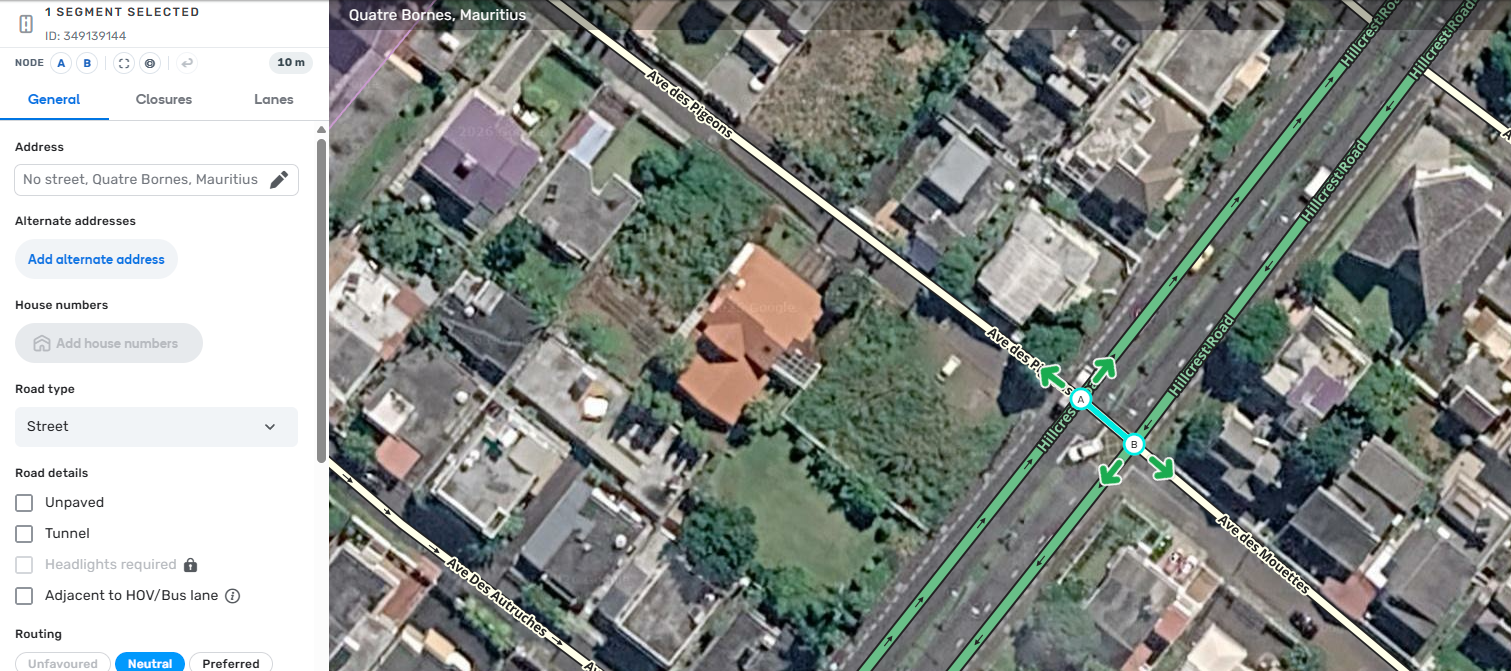
This example shows the full benefit of leaving the central segment (between the 2 carriageways of Hillcrest Road, Quatre Bornes) unnamed.
When going along Hillcrest Road north-eastwards and wanting to turn right towards Ave des Mouettes, the unnamed segment will inherit the name Ave des Mouettes (the next named segment on the route) for the navigation instruction: “Turn right onto Ave des Mouettes”
On the other hand, when going along Hillcrest Road south-westwards and wanting to turn right towards Ave des Pigeons, the same unnamed segment will this time inherit the name Ave des Pigeons for the navigation instruction: *“Turn right onto Ave des Pigeons”