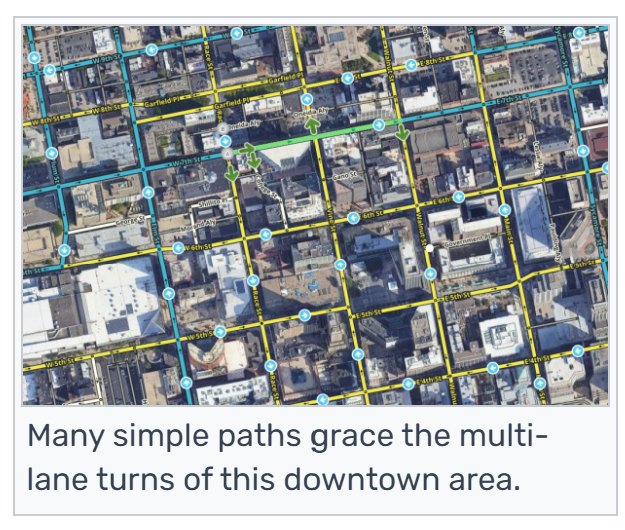
Yes, exactly. I thought that the “when to map” stuff for far lanes (not every reason for paths) had already been proposed at the champ level several weeks ago, which is why I added it to the page, with some paraphrasing for readability.
Maybe I’m mistaken about that, since I’m not part of those discussions. Or if it was proposed, and there were no objections, that could mean agreement, or it could just mean that the discussion never took off. Regardless, any decision on the use of a big new feature like this needs a consensus from you guys, especially the RCs, who lead our editor communities. Even if I were to add it to the wiki, that just means it’s in the wiki, not that people will read it and follow it 
Here’s the proposed guidance for far lanes from my draft:
[quote=“draft” post_id= time= user_id=]
Use far lanes when necessary to provide one or both of the following benefits:
- More complete lane guidance at multi-node intersections that divided-road heuristics cannot combine.
- More specific, preferred lane guidance through a junction based on a later turn.
For combined lanes the question simply revolves around what constitutes a “single intersection.” If unsure, check street view and imagine if you as the driver would see all the roads meeting together as one large intersection or not. Check lane signage and pavement markings and try to match Waze to what the driver sees. The basic cases are # or H intersections, intersections with at-grade connectors, and combinations of the two.
Preferred lanes should be set for any multi-lane movement where you’re already getting an instruction and where the best lane to choose at the movement depends on which movement you’re going to make next. Any time you have two or more lanes going through the same turn, exit, or keep, you should consider preferred lanes. Look for applicable later movements which are close enough to make a difference about which lane to be in earlier. A good yardstick is “within about the next minute” for whether a later movement is close enough to need preferred lanes. This means about 1 mile on a 60-mph freeway, much shorter at surface speeds; use your best judgment.
Another valid use of preferred lanes is where you wouldn’t have otherwise received an instruction. For example, if you have two freeway exits on the same side about a mile or less apart, and the first one has an exit-only lane of any kind, then a view only straight at the first exit for the second exit’s lane(s) can be very helpful. If the second exit is multi-lane, you can even use that view-only to direct people into the correct lane for the 2nd exit.
This can also be done at a smaller scale on surface streets; if you have a series of hard to predict turn-only lanes then drivers can use the help.
Include the lanes that a driver actually uses through a far turn, even if overhead signage doesn’t point to them. If one lane merges into another after a turn, include both lanes to promote the merge at the proper point, rather than selecting only the continuing lane.
[/quote]
So let me know what you guys think. Do you want to discuss the guidance part here? Should I leave it out and let the community leaders continue to discuss it elsewhere? I am fine with publishing a purely informational page, but it looks like we need some wiki updates, so I’m trying to help with that.