Template of topic 380525, post 1
Template of topic 380019, post 1
Mapping a sharp curve
Before mapping a sharp curve, please accurately align the segment as per the guidelines at road alignment and angles.
Sharp curves may be mapped in the following circumstances.
Hairpin turns/bends
Hairpins can be identified by the following characteristics:
- Used to ascend or descend steep topography.
- Involve approximately a 180 degree change of direction or greater in a short distance.
- Are usually a single lane each direction.
- Require significantly reduced speed to handle the turn safely.
Place the sharp curve hazard at the apex of the hairpin turn so that 500m notice can be provided to drivers in each direction.
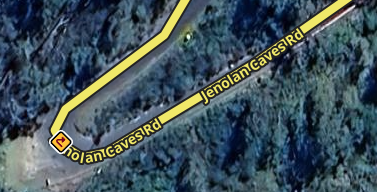
An example of a hairpin turn/bend seen in Australia where the mapping of a sharp curve is acceptable.
Advisory signage
Where there is a difference of 50km/hr or more between a yellow, orange or red speed advisory sign and the road speed limit (speed in red circle on white background or a variable speed limit sign). Ignore school or variable time based speed limits in calculations.
For example the posted speed limit is 100km/hr and an advisory speed for a curve is 45km/hr - the speed difference is 55km/hr (greater than 50) and should be mapped as a sharp curve.
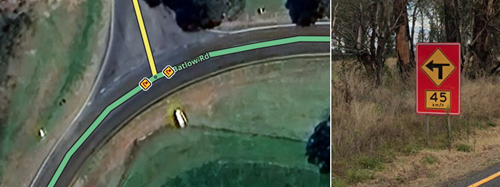
An example of advisory signage where the speed drops by 50km/hr or more and should be mapped
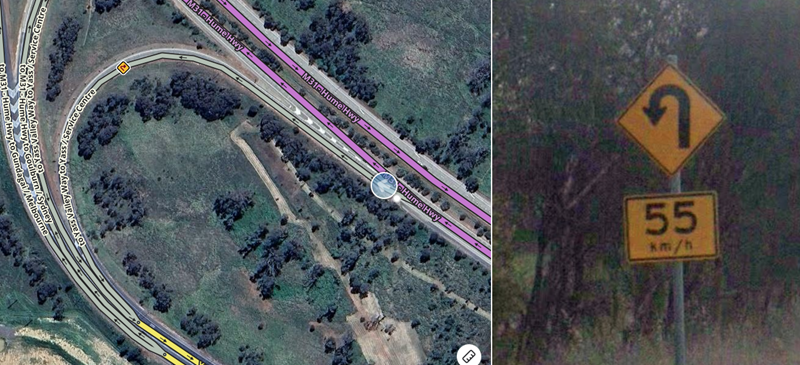
An example of advisory signage where the speed drops by 50km/hr or more and a sharp curve should be mapped - ramp speed is 110km/hr, advisory speed is 55km/hr, difference is 55km/hr (which is 50 or more).
Red reduce speed sign
Where there are no reduced speed limit or advisory speed signs ahead of a sharp curve but a red reduce speed sign is used directly ahead of the curve to reduce driver speed, a sharp curve may be mapped.
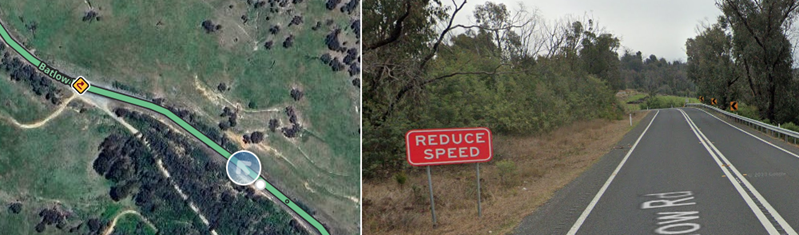
An example of a red reduce speed sign before a curve, where the mapping of a sharp curve is acceptable.
Apex Intersection
Where there is an intersection at the apex of a sharp curve, map two sharp curves each set to one-way so there is no alert for drivers entering from the non-hazardous direction.
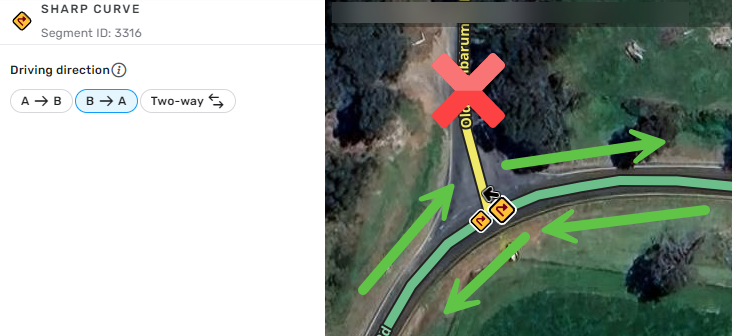
An example of an intersection at the apex of a sharp curve where permanent hazards should be mapped as one way to avoid alerts to drivers joining from the apex.