Hello,
I’ve noticed that this hazard is being used at many intersections in CDMX.
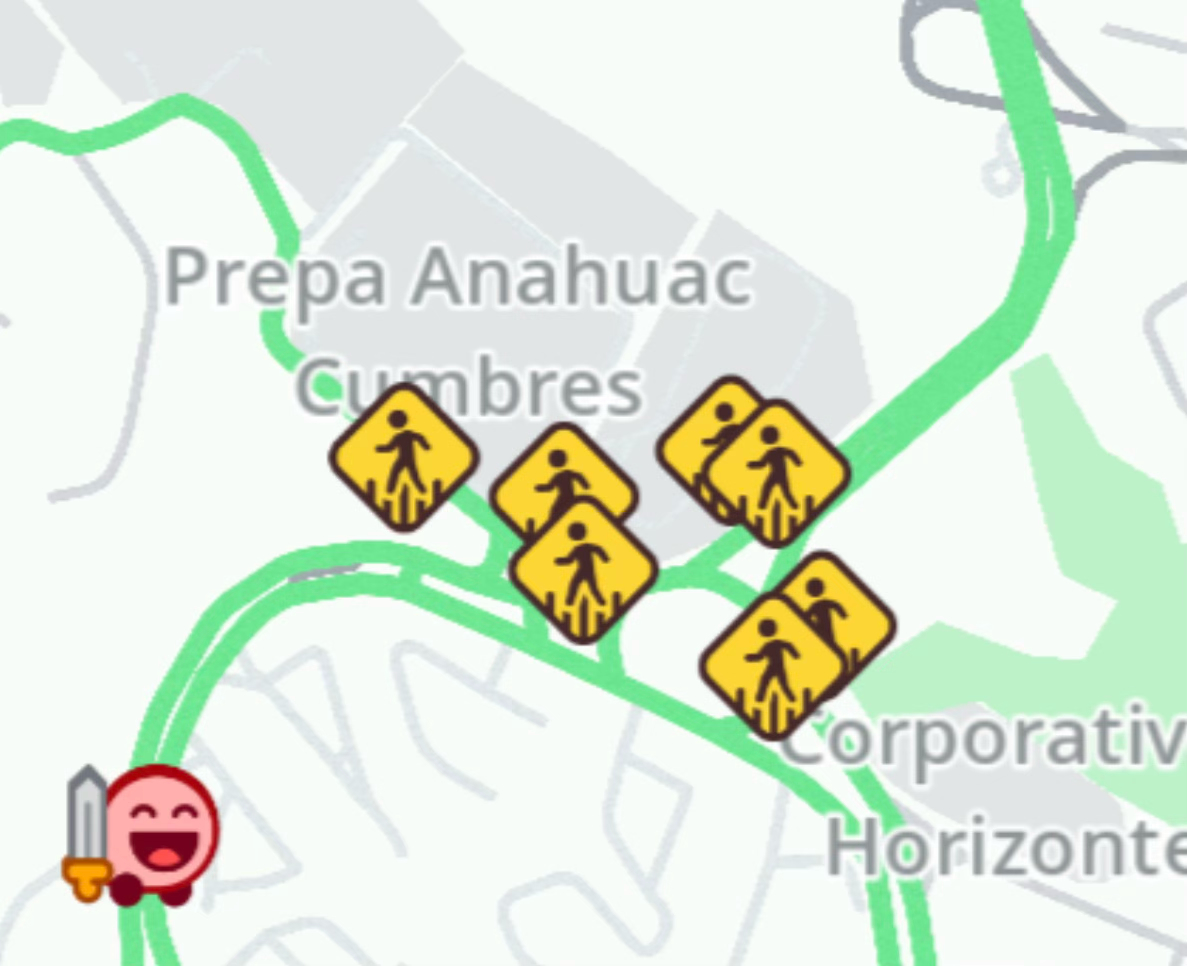
When should they be used? I think in very few cases and we shouldn’t clutter the map at every crosswalk.
Regards,
I appreciate you bringing this topic up. I sent you a direct message to discuss it but didn’t get a response, so I’ll clarify it again here: you did indeed remove those alerts in Mixcoac and now in this section without any prior debate or consultation. Given the lack of written guidelines in Mexico for these new crossings, I propose reserving their use for segments that meet at least 2 of these 3 conditions: 1) Lack of protective infrastructure (no traffic lights or physical speed reducers), 2) Risk due to approach speed or geometry, and 3) Areas with high pedestrian accident rates. The Pabellón Bosques Roundabout meets all three criteria and stands out in the official 2025 SEMOVI data for the Cuajimalpa borough. It’s not about cluttering the map, but about flagging critical points where a warning can prevent pedestrians from being struck. I look forward to hearing the community’s stance to define the criteria for adding or removing alerts. Regards.
Hi @netogrimald, I’ve just checked your information and what was shared by @velezss, and I indeed noticed that the alerts were removed from the map. I think it’s important to point out that this is an intersection where I see a need to map alerts; if there are statistics, markings in the area, and high foot traffic during the day, mapping is necessary. As is the case here, we know that alerts can represent an inconvenience for some users when driving, but most desire and hope to have all these necessary preventive alerts mapped. For this reason, I disagree with the removal of these alerts without prior consultation, especially since a post or a message to the person who placed them would allow for necessary actions and further discussion between both parties if they need to be added.
For example, some hospitals have people circulating through labs, pharmacies, medical tests, etc., all day long, and this is usually in the same area near the facilities. This is why I consider it necessary to map them; regards, and I hope my comment is helpful.
We’ll check with the staff to see who deleted those alerts without consulting first.
@netogrimald, could you re-add the alerts you had posted before they were deleted?
Regards.
Neto: I find your justification very sound, especially if these alerts serve to save pedestrian lives—they are completely justified since they are located on a curve not visible to drivers, particularly when they are traveling at high speeds.
I do not agree with them being removed unilaterally without consulting the author, especially when that is the principle being championed.
The general consensus currently being discussed is that, for the moment, if a user requests alerts, they should be added—even if the map gets cluttered and not everyone likes it. That isn’t the users’ problem; it’s a problem that Waze’s UI/UX team needs to solve. If a user asks for it, it gets added, and Waze can figure out its UX.
On the other hand, there was already a situation where people were asked to be considerate of other users before making modifications like deleting alerts, messages, or similar. We were just saying that things need to be reciprocal for everyone, rather than just asking for things when it’s convenient.
That is exactly the reason for this post, to reach a discussion on what to do in CDMX, which is why the post is in this forum. Other regions will have the opportunity to create their own rules later.
At least in CDMX, none of the Champs who drive in this city have posted any comments about it.
I would say the opinion of those who drive regularly in CDMX.
I believe that having every speed bump, intersection, and raised crossing only causes people to turn them off because they stop being effective.
The speed limit is 50 km/h. What qualifies as a “high-speed road”?
I highly doubt that; most people (users who don’t visit the forum) I’ve asked in CDMX what they think of so many alerts say that it’s making Waze alerts useless. We have speed bumps, pedestrian crossings, raised pedestrian crossings, potholes, and stopped vehicles regularly in stretches of less than 1 km.
Now that the meetup is coming up, I invite you to drive in that area on Friday so you can see how Waze behaves during rush hour.
You don’t need to go to the staff; it was me, and that’s why I opened this post so we in CDMX can come to an agreement.
I understand that in Hermosillo they want to map everything, but as I stated above, Waze has become overloaded with too many alerts in CDMX.
And if many users ask for them to be removed, are they removed?
It’s not about how many people ask for it; it’s about the process. A documented request must be made (UR or forum) + consultation with another editor before taking action (something you yourself have requested)—the same applies to adding as it does to removing.
When I said “if a user asks for it, it gets added,” I was referring to something specific and based on criteria, like netogrimald’s post. That’s different from “many users think they’re unnecessary” in a general, undocumented way, because “many people told me” isn’t verifiable and opens the door for anyone to justify deleting things simply because they or their group find them in the way.
If many people ask to remove them, it gets evaluated, but following the same criteria and consulting first. That is exactly what didn’t happen here.
We aren’t looking for unilateral actions; if you don’t like how it looks, I suggest you submit a proposal on User Voice so Waze can improve the UX for permanent Hazards.
It’s not just that I don’t like it, but also that people who know I edit the map have asked me to be selective with the alerts.
In all the years I’ve been with Waze, we’ve adapted the resources we’re given to try to create the best experience for users.
Unfortunately, User Voice suggestions are practically ignored by the staff, as are the comments made at meetups (example: that speed bumps should only alert at night).
Just as “many users” is not verifiable, “the people who know I edit have asked me” isn’t either.
No names, no specific source. If there is a real request to be more selective, provide documentation; you know this because for a long time you were the main promoter of this (forum posts, UR, meetup) and it is evaluated with the same criteria as any other request. Otherwise, we are left with the same problem: unverified opinion to support a unilateral action, when you had previously asked for this not to be done and for there to be cordiality.
Regarding the fact that User Voice is ignored, that may be true, but it’s an argument to persist through that channel or escalate it formally, not to bypass it and delete on your own what someone else added. If the process is broken, you fix the process; you don’t replace it with individual judgment.
And the core issue remains: consulting before acting. You didn’t do that here.
Well, for now, on my part, I’ve sent suggestions on how to correct those errors; I’ve driven not only in Mexico City but in various parts of the country at different times, days, and places. But I understand that decision-making isn’t just for a few cities or groups of people, but at a national level (not everyone thinks the same).
In this case, I believe that @netogrimald, who is local to the area, placed the pedestrian crossing alert on the expressway for a reason. He didn’t just come to spam the area but wanted to provide information to drivers, and he was never sent a message to get his opinion or, above all, to reach an agreement with those we share the area with. On the contrary, his alerts were deleted, and it is being inadequately justified.
I understand the frustration with the topic, but it’s not about thinking of oneself, but of the entire community.
This is a post in the South-Central region.
Some things can work differently in the regions. That’s why I started it here.
regards,
The good thing is that I have national editing access and I’ve been contributing for a few months now in the south-central region, thanks to the community. Regards.
You shouldn’t have deleted those PHs since you didn’t create them.
Where I live or where I edit is irrelevant; the big problem is that if you and your close group of friends don’t like something, you think it shouldn’t exist on the map. That’s not how things work.
Please avoid deleting those types of objects on the map if a high-level editor placed them, as your level could be lowered for not respecting what someone else added, yet everyone else is expected to respect what you put on the map.
I completely disagree with deleting comments, segments, alerts, or any other editor’s edits without a conversation first, especially if it is a recent edit.
Regarding permanent hazards, we were never able to reach an agreement as a community. It was always a relative situation of one point of view against another. That is why I believe that for the sake of absolutes, it is either everything or nothing. I am on the side of putting absolutely everything that appears in the permanent hazards menu on the map.
It is the staff’s problem and responsibility, specifically the UI department, to handle i) how they look, ii) when they are seen, iii) how they are announced, and iv) in what context. An example of this is that other communities are already having issues.
I agree with Manuel. Right now, I can’t keep up with adding so many speed bumps. Why? Because the way I see it, THE USERS are asking for it. If Manuel or Santiago or whoever and their inner circle don’t like it, there’s another large group of strangers reporting many speed bump alerts every day. So I map them. It will be up to Waze to create a more user-friendly or specific UX regarding the types and subtypes of alerts we want to receive or not. Now then. Specifically regarding the pedestrian crossing alert on high-speed roads, it’s clear to me. It’s a very wide speed bump that acts as a pedestrian crossing, usually marked with a zebra crossing, located on a highway. If it’s not a highway, I could mark it as a raised pedestrian crossing (I think in CDMX this would be the alert to use. Unless there was something like that on a high-speed road (80 km/h or more)). And regarding deletions, I find it strange that when a comment is deleted that is clearly correct (based on GPS points, Street View changes, and satellite imagery) we’re asked to consult the creator, but now it turns out deletion decisions are being made just because I or my friends don’t like it. In my opinion, if someone tells me “Hey, Waze alerts you about everything now and it’s unbearable,” I’d guide them to the settings so they can choose the option to not be alerted about anything, and that’s it!
So in this case, which is when I got the first alert when I passed through, it shouldn’t be marked, as there is a speed bump a few meters before:
If my level has to be lowered, go ahead. Whatever you think is best for the community.
Some of these require interpretation and consensus, and that’s exactly the point of this discussion.
When is a road considered an expressway in CDMX? Those with an SL of 80 km/h, 60 km/h, 50 km/h or 40 km/h? The hazard label is called “Pedestrian Crossing on Expressway.” If there is a speed bump a few meters before, should it be marked?
What is a complex intersection?
When several lanes merge? When streets join and lanes disappear? Or if lanes join and don’t disappear?
That’s why simply going with an interpretation of marking everything isn’t possible; an analysis must be done.
The crossings at the Glorieta de Bosques don’t meet any of those requirements.
The response I get is: “I want it to alert me about speed bumps that I could actually hit too fast because they aren’t well-marked—that’s why they’re called alerts.”
Most people aren’t as crazy as we are to come and discuss things in a forum.
[quote=“velezss”, post:17, topic:410710"]
If I should be demoted, go ahead. Whatever you think is best for the community.
[/quote]
In this post, what did you expect would happen by posting this comment?
How should one proceed in that case?
I already know that post is about a map comment in a region outside of where you live/drive, and that it is supervised by other people and not in the South-Central region. This is just so you avoid saying it is not a relevant topic to this region, but what is relevant is the respect for current objects on the map.
As a driver in CDMX, I can say that I don’t agree with mapping every alert; personally, I’ve seen several cases that seem unnecessary and even ridiculous to me (like placing a speed bump alert and then another alert for the same thing 5 meters later).
And even though we don’t have a uniform set of criteria in Mexico for placing alerts, I don’t think it’s right for a user (without consulting anyone, whether it’s the author of the alerts or a Champ) to go around deleting someone else’s alerts.
This issue could have been avoided if there had been a little bit of dialogue between the parties instead of an imposition of criteria.
Map comments aren’t visible in the app; it’s something completely different.
How do you propose the rule should be?
