Feature Summary
time information is particularly useful to provide insights used
a) for routing decisions such as deciding which route to take, or trying to get a sense of what is happening ahead, reasons for traffic and
b) to stay safe and informed on what is ahead on your current road such as police, speed cameras, dangerous curves, sudden slow down etc.
Permanent hazards (PH) are meaningful road insights that users would want to know while driving. Alerts will encourage users to slow down and drive more safely saving not only drivers lives but pedestrians too
Please see below the hazards that are be available:
- Speed Cameras
- Railway crossing
- Speed Bumps
- Dangerous curve
- Dangerous split
- Dangerous merge
- Dangerous Intersection
For all the dangerous PH, the idea is to warn users of certain entities that might have a higher probability of accidents due to the complexity of them.
PH as a feature is locked to L4 and above. If you are below that level, you can request the addition of PH using the usual community communication channels.
It is important to know while editing PH that there is a familiarity capping for PH. If on a 500m part of an itinerary, there are multiple PH, only the first of those will be shown. This is to avoid alert spamming for the end user. Therefore, it is not needed to add all speed bump of a street for example. Only the first one should be added, since the following ones (within 500m) will not be shown in the app anyway.
You will also keep in mind that as a driver using Waze, you don’t want to be spammed continuously by PH alerts. Hence, only the most relevants PH should be on the map.
How and when use PH in EAC ?
Cameras
All FIXED speed cameras should be on the map, with correct direction and speed settings. We will never add on WME mobile speed cameras or mobile police controls. Those should be reported as “Police” on the app by the wazer.
Railway crossings
All railway crossings (RC) should be on the map. Those alerts are bi-directional and have to be placed at the exact location of the crossing.
Speed Bumps
Speed bumps (SB) are very common within the EAC road network, and those may sometime surprise the driver, especially on highways outside of towns. It can therefore be very useful for drivers to get an alert ahead.
Within towns, you can put all SB, but it might not be useful as you need to keep in mind that for all SB within a 500m portion of your itinerary, you will only receive one single alert.
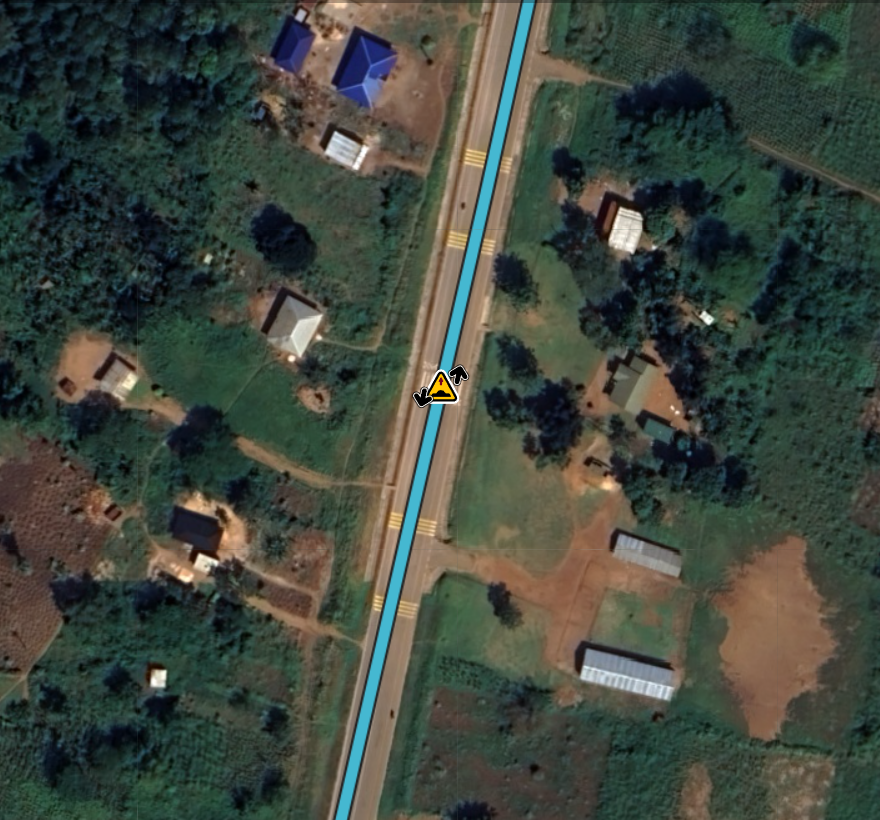
In case of small speed bumps ahead of a large hump, only the hump will be marked, as it is the one which might pose problem, when the smaller one are another reminder of the hump ahead.
Dangerous Curve
This PH should be used only on accident-prone curves, or at the first dangerous curve of a mountain road. Again, the first occurrence is important to mention. Then, you don’t want to spam the users, nor disturb him, with the subsequent curves, in a drive that will require his/her full attention. It is important to keep in mind what the driver need: in this case, a warning for a dangerous curve after several kms of straight and smooth driving.